
Ankle pain is one of the most common complaints we see at Phoenix Physio, and it’s easy to understand why. Your ankles carry your full body weight with every step, absorb impact when you walk, run, or climb stairs, and constantly adjust to uneven ground to keep you balanced. It doesn’t take much — a missed kerb, an awkward landing during sport, or months of wear and tear — for pain to set in.
Ankle pain can range from a dull, everyday ankle soreness to sudden, extreme pain in ankles that stops you from putting any weight down at all. Whatever form it takes, it can quickly limit the things you’d normally do without a second thought — walking the dog, climbing the stairs, or staying active at the gym. In this guide, our physiotherapists based near Wendover and Aylesbury explain what causes ankle pain, the warning signs to watch for, and how physiotherapy can get you moving again — safely and for the long term.
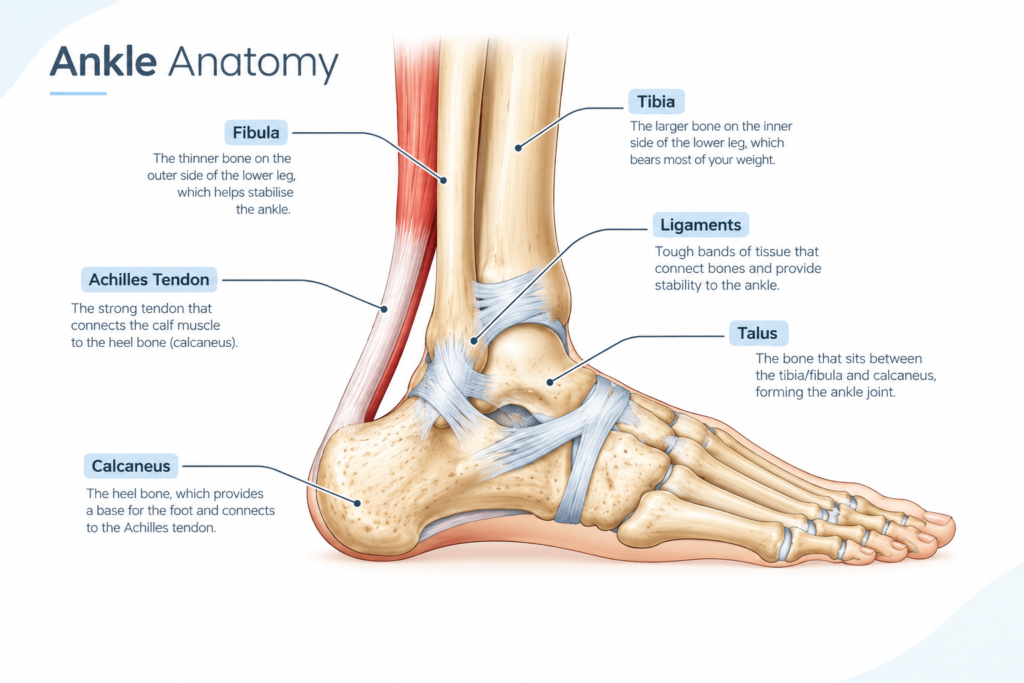
Ankle Anatomy 101
The ankle is a complex hinge joint formed by three bones: the tibia (shin bone), fibula (outer leg bone), and talus, which sits between them like a hinge inside a stabilising arch called the mortise. Just below sits the subtalar joint, between the talus and the calcaneus (heel bone), which lets the foot tilt side to side.
Holding everything together are the ligaments: the lateral ligaments on the outside (most commonly injured when the foot rolls inward), the stronger deltoid ligament on the inside, and the syndesmosis ligaments, which connect the tibia and fibula above the joint itself — an injury here causes a “high ankle sprain” that takes longer to heal. The Achilles tendon, the largest tendon in the body, runs down the back of the ankle and is essential for walking, running, and pushing off the ground.
The ankle allows four key movements — dorsiflexion (foot up), plantarflexion (foot down), inversion (sole inward), and eversion (sole outward). Because so many structures are packed into such a small joint, it’s inherently vulnerable to injury, especially when forced beyond its normal range.
Common Causes of Ankle Pain
Ankle pain can strike suddenly or build up gradually. The most frequent cause is an acute sprained ankle, where the ligaments are stretched or torn from a twist or misstep — usually affecting the outside of the joint.
Sudden injuries include:
- Sprains and strains – ligament or muscle/tendon damage from rolling the ankle inward
- Fractures – cracks or breaks in the tibia, fibula, or talus, often causing sharp pain in the ankle bone, swelling, and inability to bear weight
- High ankle sprains – injury to the ligaments connecting the tibia and fibula, from twisting or contact sports
Gradual, overuse-related causes include:
- Achilles tendinitis – inflammation from repetitive stress, common in runners, causing pain back of ankle
- Bursitis – inflammation of the fluid-filled sacs cushioning the joint
- Plantar fasciitis – pain along the sole that often radiates toward the heel
- Tendinopathy and impingement – wear-and-tear or pinching of soft tissue, sometimes felt as pain at top of ankle during certain movements
Signs & Symptoms to Watch For
Ankle pain doesn’t feel the same for everyone, and different ankle pain areas often point to different problems. Pain on the inner ankle can signal posterior tibial issues, while outer ankle pain often relates to peroneal tendon problems or a lateral sprain.
Common symptoms include pain ranging from dull ankle soreness to sharp, extreme pain in ankles; swelling and bruising; ankle stiffness and pain that’s worse first thing in the morning; a feeling of instability or “giving way”; warmth or redness (a sign of inflammation); and clicking, popping, or difficulty bearing weight.
As a quick reference, here’s how symptom patterns often line up with likely causes:
Symptom Pattern | Possibly Indicates |
Sudden pain, swelling and bruising after a twist | Ankle sprain |
Sharp pain at the back of the ankle, worse after exercise | Achilles tendinitis |
Pain at top of ankle during movement | Tendinopathy or impingement |
Pain in the sole/heel, worse with first steps in the morning | Plantar fasciitis |
Ongoing stiffness and swelling, worse over time | Arthritis |
Severe pain, unable to bear weight, visible deformity | Possible fracture (seek urgent care) |
When to See a Physiotherapist (Red Flags)
Most ankle pain responds well to physiotherapy, but some symptoms need urgent medical care first.
Seek Urgent Care (A&E) If You Have… | Book a Physiotherapy Assessment If You Have… |
Inability to take four steps in a row on the injured foot | Persistent pain not improving after a few days of rest |
Visible deformity of the ankle or foot | Ongoing swelling lasting more than a week |
Numbness, tingling, or coldness in the foot | A feeling of instability or the ankle “giving way” |
Foot turning pale or blue | Stiffness lingering after initial pain settles |
Massive or rapidly appearing swelling | Chronic soreness that keeps returning with activity |
A loud pop or snap heard at the time of injury | Pain that’s gradually worsened over weeks or months |
As a rule of thumb, if pain, swelling, or instability lasts more than 48–72 hours, or keeps coming back, it’s worth getting properly assessed rather than waiting it out.
How Physiotherapy Diagnoses Ankle Pain
At Phoenix Physio, diagnosis combines a detailed history with hands-on physical examination. We start by understanding when and how your pain began, what makes it better or worse, and any previous ankle injuries or activity demands.
The physical exam includes palpation to pinpoint tenderness (often guided by the Ottawa Ankle Rules to determine whether an X-ray is needed), range of motion testing, ligament stability tests such as the anterior drawer or talar tilt test, and strength testing of the calf, shin, and foot muscles. We then assess function through gait analysis and movement screens — single-leg stances, squats, or heel raises — since ankle problems can sometimes stem from issues higher up the chain. If a fracture or significant soft-tissue tear is suspected, we’ll refer you for imaging before proceeding with treatment.

Physiotherapy Treatment Options
Treatment is tailored to your specific injury and goals and typically combines several approaches:
- Manual therapy – joint mobilizations and soft tissue massage to ease stiffness and improve circulation
- Exercise rehabilitation – progressive strengthening for the calf, shin, and foot, alongside range-of-motion work
- Balance and proprioception training—exercises on unstable surfaces, like single-leg stands or wobble boards, to retrain joint awareness and prevent reinjury
- Swelling and pain management—ice, heat, taping, bracing, or ultrasound therapy where appropriate
- Education and advice—guidance on footwear, activity pacing, and safe return to sport
Recovery generally progresses through four stages: the acute phase (reducing pain and swelling), the restoration phase (rebuilding motion and strength), the functional phase (balance and activity-specific training), and finally a graded return to activity.
At-Home Self-Care & Exercises
For mild to moderate pain, the RICE method (Rest, Ice, Compression, Elevation) is the standard first step: avoid weight-bearing where pain is significant, apply an ice pack wrapped in a towel for 15–20 minutes several times a day, use a light compression bandage, and elevate the foot above heart level.
Once acute pain settles, gentle exercises help restore movement: ankle circles and pumps, the alphabet exercise (tracing letters in the air with your big toe), a calf stretch against a wall, heel raises (2–3 sets of 8–15 reps), and single-leg balance holds of 20–30 seconds. Keep pain during exercise between 0–5 out of 10, and stop immediately if it becomes sharp or worse. Choose supportive, well-fitted footwear, warm up before activity, and build up intensity gradually rather than jumping back in at full speed.`

Preventing Future Ankle Injuries
Once your ankle has recovered, prevention becomes the priority — especially after a previous sprain, which significantly raises the risk of repeat injury. Keep up strengthening work using resistance band pulls, calf raises, and toe scrunches (3 sets of 10–12 reps), and continue balance training with single-leg stands or a wobble board.
Choose supportive shoes with good grip and firm heel support for your activity, replacing trainers roughly every six months if used regularly. Increase walking or running distance gradually — no more than 10–20% per week — and consider a lace-up or semi-rigid brace during high-risk sports if your ankles feel loose from past sprains. Don’t push through new or returning pain; early reassessment prevents small issues becoming chronic ones, and a physiotherapist-guided, graded return to sport is one of the best ways to avoid repeat injuries.
Ready to Put Your Ankle Pain Behind You?
Every step matters — literally. Whether you’re dealing with a fresh sprain, an old injury that never quite healed, or an ankle that just doesn’t feel as steady as it used to, you don’t have to keep working around it.
What Makes Phoenix Physio Different
- We treat the cause, not just the symptom — a proper assessment before any treatment plan
- Hands-on, personalised care — no generic exercise sheets, no rushed 10-minute slots
- Local experts, real results — 5-star reviews from patients across Wendover & Aylesbury
- Fast access — early appointments, no long waiting lists
“Don’t let ankle pain quietly limit your life. The sooner it’s assessed, the sooner you’re back to moving without thinking twice about it.”
Your Next Step Is One Click Away
Whether it’s a nagging ache, a recent twist, or an ankle that keeps giving way—our physiotherapists in Wendover & Aylesbury are ready to help you get back on your feet properly.
Or call us directly on 01296 254877—we’re happy to answer any questions before you book.
Frequently Asked Questions
Physiotherapy is a science-based profession that helps people with injuries, illnesses, or disabilities through movement, exercise, manual therapy, and education.
We treat painful joints, backs, necks, sports injuries, and rehabilitation after surgery or strokes, to name but a few.
Your physiotherapist will ask about your condition, its history, and what makes it better or worse, then assess your posture, movement, and limbs.
Use one of the 'Book Appointment' buttons on this page, or call the clinic directly on 01296 254877.
Loose-fitting clothing and footwear — you may need to remove or move clothing so we can access the treatment area.
Relevant medical reports, scan or X-ray results, and any supports or braces you use. Bring a relative too, if helpful.
Some insurers can be worked with directly, or we can provide receipts for reimbursement. Contact the clinic before booking to confirm.
This depends on your injury or condition — your physiotherapist will recommend a course of treatment and follow-ups as needed.