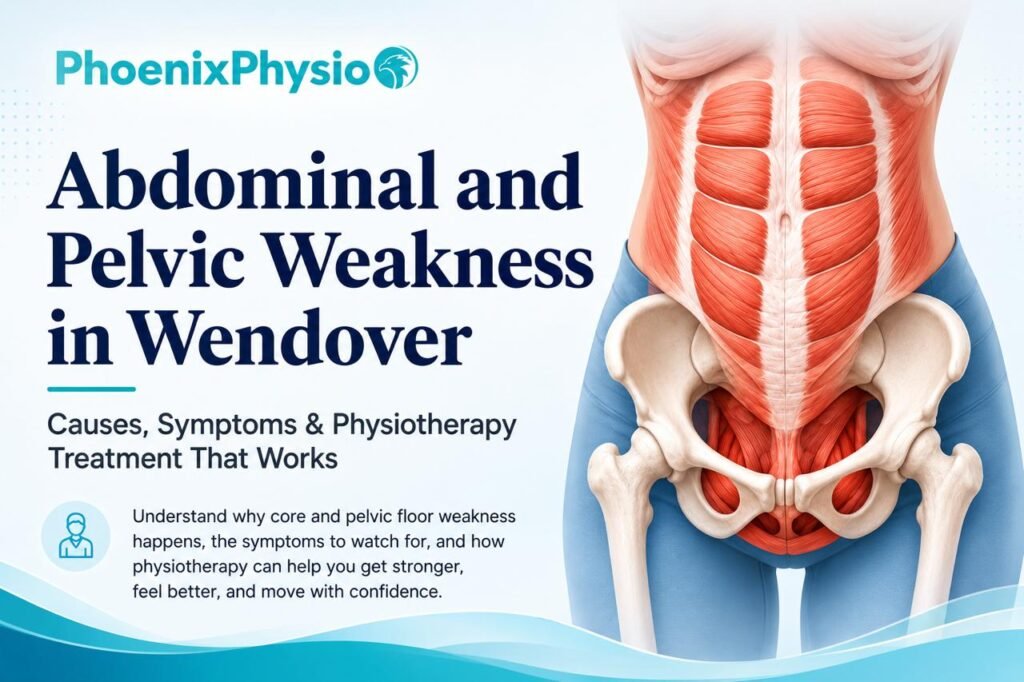
Introduction
Quick answer: Abdominal and Pelvic Weakness in Wendover happens when your core and pelvic floor muscles lose strength or stop coordinating properly — often after pregnancy, surgery, ageing or inactivity. It can cause back pain, urinary leakage, and a heavy feeling in the pelvis. The good news: it’s one of the most treatable conditions physiotherapists see, with many people noticing improvement within 6–12 weeks of a tailored programme.
If you’re based in Wendover and searching for answers about pelvic weakness, core instability, or postpartum recovery, this guide explains what’s happening in your body — and what you can do about it.
What Is Abdominal and Pelvic Weakness?
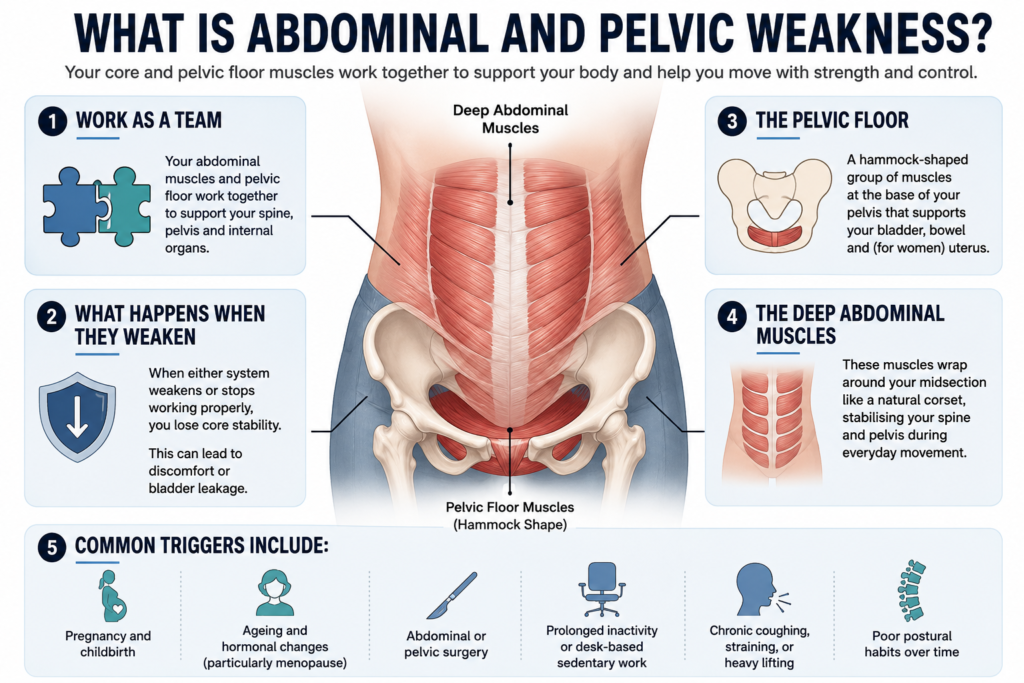
Your abdominal muscles and pelvic floor work as a team. The pelvic floor is a hammock-shaped group of muscles at the base of your pelvis that supports your bladder, bowel and (for women) uterus. Your deep abdominal muscles wrap around your midsection like a natural corset, stabilising your spine and pelvis during everyday movement.
When either system weakens — or when they stop firing together properly — you lose core stability. That can show up as anything from mild lower back discomfort to noticeable bladder leakage.
Common triggers include:
- Pregnancy and childbirth
- Ageing and hormonal changes (particularly menopause)
- Abdominal or pelvic surgery
- Prolonged inactivity or desk-based sedentary work
- Chronic coughing, straining, or heavy lifting
- Poor postural habits over time
Symptoms to Watch For
Weakness in this region rarely announces itself as one clear symptom — it’s usually a cluster of small, easy-to-dismiss signs:
Symptom | What it can feel like |
Stress incontinence | Leaking when you cough, sneeze, laugh, or exercise |
Pelvic heaviness | A dragging or “everything’s falling” sensation |
Lower back pain | Aching that worsens with standing or activity |
Reduced exercise tolerance | Running, lifting or twisting feels unstable |
Bowel changes | Constipation or difficulty controlling wind |
Postural fatigue | Struggling to sit or stand upright for long periods |
A note on pelvic pain specifically: pain can present very differently from person to person — aching, burning, sharp, cramping, or a constant pressure. Pain that’s localised to one side (for example, persistent left-sided pelvic discomfort) is not automatically a sign of muscular weakness. It can stem from gynaecological, urinary, gastrointestinal or musculoskeletal causes, so one-sided or unexplained pain should always be assessed by a GP or physiotherapist rather than self-managed.
Why Pregnancy and Childbirth Are Such Common Triggers
Pregnancy places sustained load on the abdominal wall and pelvic floor for nine months — and childbirth adds further mechanical stress, particularly with vaginal delivery.
What typically happens:
- The abdominal muscles stretch to accommodate the growing uterus, and the two large “six-pack” muscles can separate at the midline — a condition called diastasis recti.
- The pelvic floor carries significantly more load throughout pregnancy and can be stretched further during delivery.
- Many people notice urinary leakage, a heavy pelvic sensation, or reduced core strength for months after birth.
Recovery isn’t automatic — it responds well to a structured, gradually progressed rehabilitation plan, which is exactly where postnatal physiotherapy makes the biggest difference.

How This Affects Everyday Life
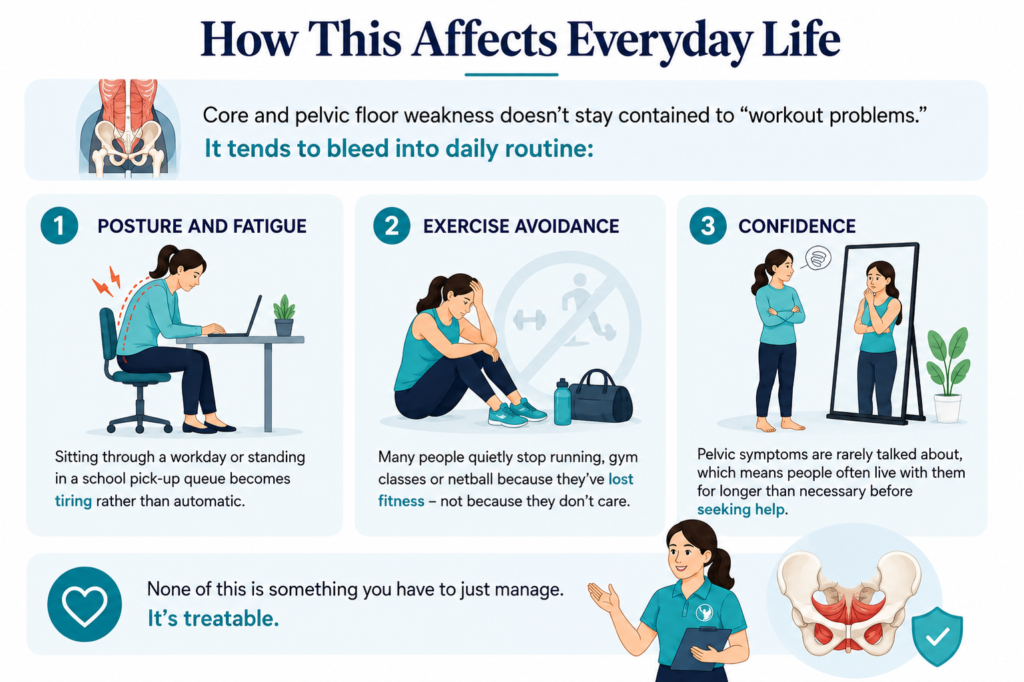
Core and pelvic floor weakness doesn’t stay contained to “workout problems.” It tends to bleed into daily routine:
- Posture and fatigue — sitting through a workday or standing in a school pick-up queue becomes tiring rather than automatic
- Exercise avoidance — many people quietly stop running, gym classes or netball because they’re worried about leaking, not because they’ve lost fitness
- Confidence — pelvic symptoms are rarely talked about, which means people often live with them far longer than necessary before seeking help
None of this is something you have to just manage. It’s treatable.
Can Physiotherapy Actually Help?
Yes — and it’s usually the first-line treatment recommended before anything more invasive is considered. A physiotherapist assesses your specific movement patterns, posture, and muscle coordination before building a plan around your symptoms, not a generic template.
What treatment can include:
- Individual assessment — some people have weak muscles; others have muscles that are overactive or tense and need releasing, not strengthening. Getting this distinction right matters, which is why self-diagnosing from a blog post (including this one) isn’t a substitute for assessment.
- Pelvic floor retraining — teaching correct contraction and, just as importantly, correct relaxation
- Deep core activation — reconnecting the deep abdominal muscles that often “switch off” after pregnancy or surgery
- Biofeedback — used where appropriate to help you feel whether a contraction is happening correctly
- Progressive loading — building back up to running, lifting or sport in stages, rather than all at once
- Lifestyle and bladder habit coaching — practical adjustments that reduce unnecessary pressure on the pelvic floor day to day
Exercises That Can Help (Start Gently)
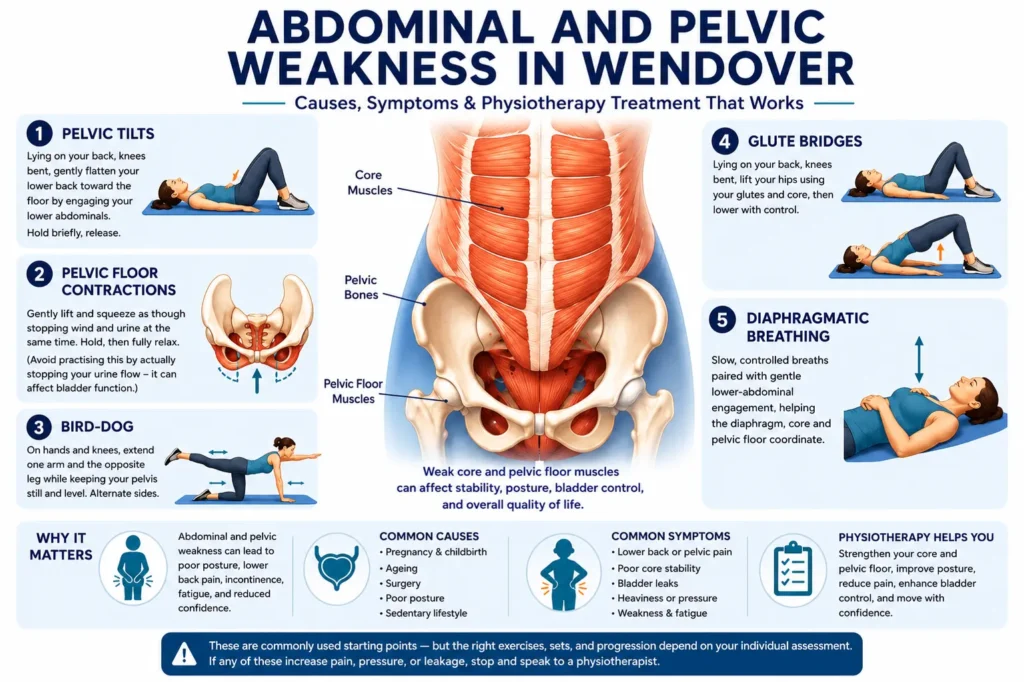
These are commonly used starting points — but the right exercises, sets, and progression depend on your individual assessment. If any of these increase pain, pressure, or leakage, stop and speak to a physiotherapist.
- Pelvic tilts — Lying on your back, knees bent, gently flatten your lower back toward the floor by engaging your lower abdominals. Hold briefly, release.
- Pelvic floor contractions — Gently lift and squeeze as though stopping wind and urine at the same time. Hold, then fully relax. (Avoid practising this by actually stopping your urine flow — it can affect bladder function.)
- Bird-dog — On hands and knees, extend one arm and the opposite leg while keeping your pelvis still and level. Alternate sides.
- Glute bridges — Lying on your back, knees bent, lift your hips using your glutes and core, then lower with control.
- Diaphragmatic breathing — Slow, controlled breaths paired with gentle lower-abdominal engagement, helping the diaphragm, core and pelvic floor coordinate.
When to See a Physiotherapist
Book an assessment if you’re experiencing:
- Leaking urine during exercise, coughing, or sneezing
- A frequent or sudden urge to urinate
- Heaviness or pressure in the pelvis
- Ongoing constipation or difficulty controlling bowel movements
- Lower back or hip pain without another clear cause
- A desire to return safely to running or exercise after childbirth
Seek urgent medical advice (rather than physiotherapy first) if pain is new, severe, or unexplained — this needs ruling out by a GP before rehab begins.
How Phoenix Physio Supports Patients in Wendover
At Phoenix Physio, [location detail — e.g. “just off the High Street in Wendover”], we see abdominal and pelvic weakness regularly across postnatal recovery, general core rehab, and ageing-related muscle changes.
Our approach:
- Initial assessment — a full review of your movement, posture, strength and symptom history
- A plan built around you — not a generic leaflet, but a progression matched to your goals, whether that’s returning to running, lifting your kids without pain, or simply standing comfortably through a workday
- Ongoing progression — regular review and adjustment as your strength and confidence improve
Frequently Asked Questions
What are the most common causes of abdominal and pelvic weakness? +
Pregnancy and childbirth, ageing, surgery, injury, inactivity, poor posture and repeated straining are common contributors to abdominal and pelvic weakness. In many cases, more than one factor may contribute to muscle weakness or reduced coordination.
Can pelvic weakness cause a heavy or dragging feeling? +
Yes. Pelvic floor weakness or dysfunction can cause a feeling of heaviness, pressure or dragging in the pelvic area. If this sensation persists or you notice a bulge or significant change, it is important to have it assessed by a healthcare professional.
What does pelvic pain actually feel like? +
Pelvic pain can feel different from person to person. It may feel like aching, pressure, cramping, burning or sharp pain and can be constant or intermittent. Because pelvic pain can have several possible causes, persistent or unexplained pain should be professionally assessed.
Can abdominal weakness cause lower back pain? +
Abdominal weakness can contribute to lower back discomfort because reduced core support may affect how your spine and pelvis handle everyday movement. However, lower back pain can have many possible causes, so persistent symptoms should be properly assessed rather than assumed to be caused by muscle weakness.
Can physiotherapy help with chronic pelvic pain? +
For many people, physiotherapy can be part of an effective approach to managing chronic pelvic pain or chronic pelvic pain syndrome. Treatment depends on the underlying cause and may include movement rehabilitation, relaxation techniques, education, targeted strengthening or other personalised approaches.
When should I seek help for pelvic weakness? +
Consider seeking professional help if urinary leakage, pelvic heaviness, bowel changes, pelvic discomfort or pain are affecting your daily activities, exercise or confidence. Early assessment can help identify the contributing factors and provide an appropriate treatment plan.
Ready to Get Assessed?
If pelvic or abdominal weakness is affecting your comfort, movement or confidence, book an assessment with Phoenix Physio in Wendover. We’ll help you understand exactly what’s going on and build a plan to fix it.